Quick answer: An LED scalp massage comb and a laser hair-growth cap serve different buying priorities. A handheld scalp comb can fit a targeted grooming and massage routine, but its LEDs do not automatically make it a clinically validated hair-regrowth treatment. Some wearable laser or LED caps have model-specific regulatory clearance for certain forms of pattern hair loss; that does not mean every cap works or that a cosmetic scalp comb has the same evidence. Start with your actual goal and check the exact device documentation.
Why “LED scalp comb vs laser cap” is a useful comparison
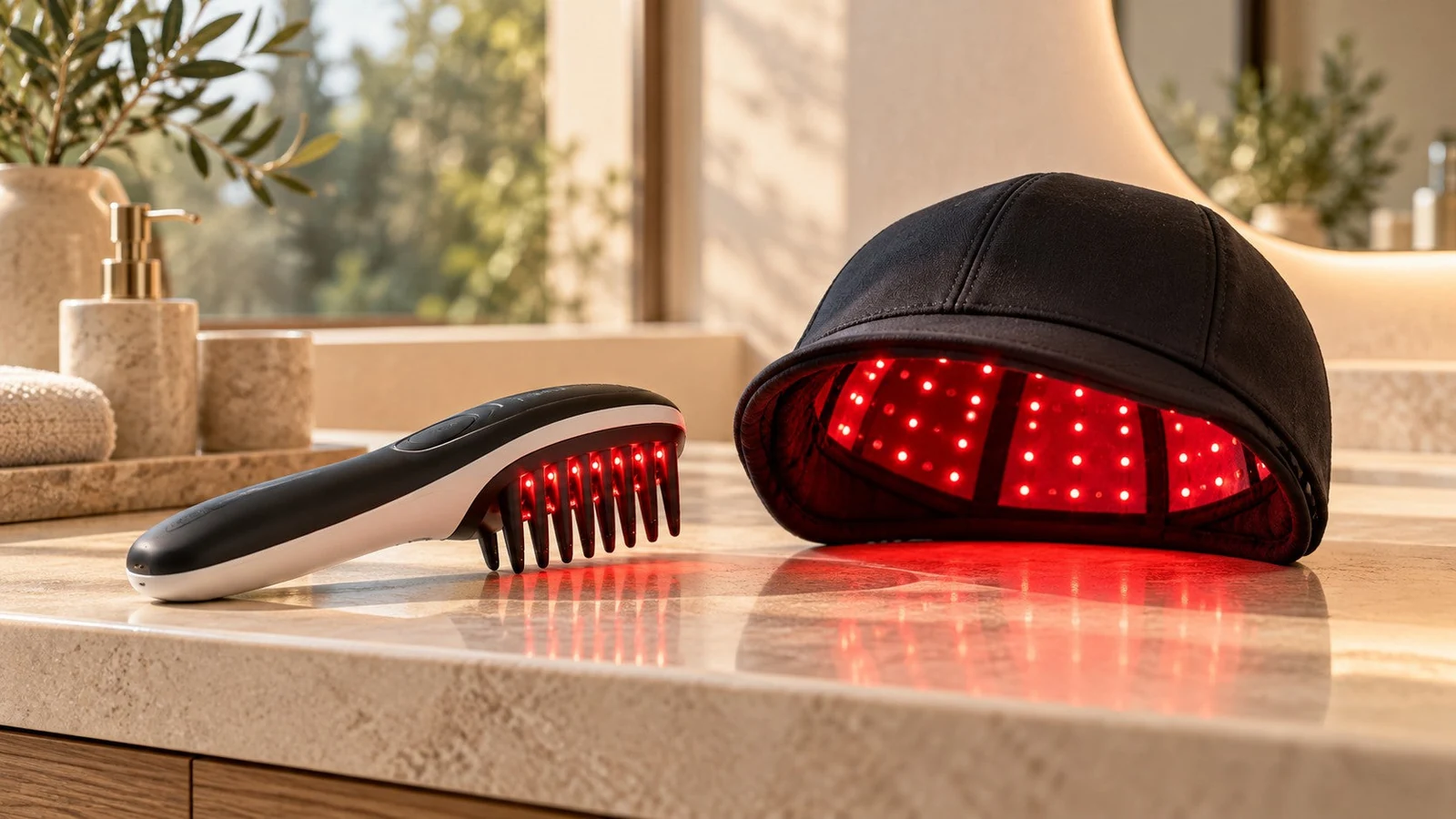
Shopping for scalp-care technology can be confusing. Sellers often group together massage brushes, LED combs, laser combs, light-emitting helmets, and wearable caps. They may look similar in an advertisement because all can involve red light, but their intended uses, coverage patterns, evidence, price, and daily routines can differ substantially. A comb is usually moved by hand across sections of the scalp. A cap is typically worn over a broader area, leaving the hands free. Neither format alone proves therapeutic performance.
If you are experiencing persistent shedding, patchy hair loss, scalp inflammation, or a rapidly changing hairline, the first step is to understand the cause. Pattern hair loss, temporary shedding, and inflammatory scalp conditions are not the same diagnosis. The American Academy of Dermatology's hair-loss guidance explains why identifying the cause matters before selecting treatment.
LED scalp comb vs laser cap: comparison table
| Factor | Handheld LED scalp massage comb | Wearable laser or LED cap |
|---|---|---|
| Typical shopping goal | Scalp grooming, massage, targeted light routine | Hands-free light exposure; some models marketed for pattern hair loss |
| Coverage | Section-by-section, depends on technique | Broader array, depending on fit and hair coverage |
| Hands-free use | No | Usually yes |
| Clinical evidence | Must be established for the exact model and claimed indication | Some specific devices have evidence and clearance; others may not |
| Hair styling disruption | Comb teeth pass through hair | Cap may flatten or compress hair |
| Important specs | Light wavelengths, output, teeth design, hygiene, battery, instructions | Device identification, clearance, wavelengths, coverage, fit, schedule |
| Most important risk | Confusing a grooming claim with a treatment claim | Assuming all caps have identical clearance or outcomes |
What exactly is an LED scalp massage comb?
An LED scalp massage comb is a handheld device intended to be moved across the scalp. Depending on the model, it may combine rounded teeth, massage functions, and light emitters. The practical attraction is a tactile scalp-care routine: you can target sections around a part line or crown and integrate the device into regular grooming. However, the presence of red LEDs alone does not establish the amount of light reaching the scalp, nor does it establish a medical effect.
BeautyTech ScalpBeam LED Scalp Massage Comb is a current product in our catalog. It should be evaluated as a scalp-grooming device unless model-specific evidence establishes an additional claim. We do not claim that ScalpBeam is FDA-cleared for hair regrowth, reverses alopecia, or produces a guaranteed density change. Check the live product listing and request the exact operating instructions before use.
Who may prefer a handheld comb?
Someone who wants a brief, tactile grooming ritual may prefer a comb over a wearable cap. The handheld form makes it easy to decide where to spend time, but it also makes consistency important. If you skip sections or move at inconsistent speeds, the light exposure will not be uniform. Do not invent a treatment schedule: use only the manufacturer's model-specific instructions.
What to check before buying a comb
Ask whether the device is intended for wet or dry hair, how to clean the teeth, how long a session should last, whether there are eye-safety precautions, and whether the light output has been independently characterized. Confirm charging instructions and return terms. A comfortable comb with clear instructions can be a useful grooming purchase without being represented as a clinical therapy.
What is a laser hair-growth cap?
A laser cap is a wearable device that uses light-emitting components inside a cap or helmet. Some use lasers, some LEDs, and some a combination. Marketing often refers to low-level light therapy or photobiomodulation. Certain models have been cleared by the U.S. Food and Drug Administration for specific hair-growth indications. The clearance belongs to the identified device and indication; it cannot be transferred to a different product merely because the LEDs are red.
When a seller says “FDA approved,” ask for the exact clearance number and product name. For many medical devices, the relevant term is “FDA cleared,” not “approved.” The FDA 510(k) database can help buyers investigate a claimed clearance. An FDA establishment registration or generic badge is not a substitute for verifying the specific claim.
Why fit and coverage matter
A wearable array is convenient only if it fits correctly. Ask whether it accommodates your head size, whether long or dense hair changes positioning, whether the manufacturer requires contact or a specific distance, and whether the light sources cover the areas you want to address. A cap with many emitters is not necessarily better: number of emitters alone does not establish an effective dose or an appropriate protocol.
What does the evidence say about light therapy for hair loss?
Some clinical research has evaluated low-level light devices for androgenetic alopecia, also known as pattern hair loss. The results are not a blanket endorsement of every consumer product. Outcomes depend on study design, the exact device, wavelength, dose, treatment schedule, participants, and duration. A positive trial involving one cap does not establish that a cosmetic LED massage comb delivers the same exposure or benefit.
The AAD includes light-based devices among options that may be considered for some patients, while emphasizing accurate diagnosis and expectations. Hair-loss treatment often requires ongoing use, and not everyone responds. If you want to treat thinning hair, compare established medical options with a dermatologist rather than buying solely from before-and-after photos.
Five buying questions that matter more than the LED count
1. What problem is the device actually intended to address?
“Healthy scalp,” “relaxing massage,” and “treats androgenetic alopecia” are different claims. Demand documentation appropriate to the claim. A cosmetic device should not be promoted as a medical device without supporting evidence.
2. Can you verify the exact model?
Find the manufacturer, model number, operating manual, and support contact. If regulatory clearance is advertised, match the exact model to the claimed indication. Be skeptical of stock photographs that show a different device from the one being sold.
3. Are wavelength and exposure instructions disclosed?
Look for clear wavelengths, session time, frequency, and positioning instructions. Claims like “professional strength” or “medical grade” are not precise technical specifications. Do not use a device for longer than recommended in hopes of accelerating results.
4. Is the routine realistic for your schedule?
A cap may be easier for hands-free use, but it must fit comfortably and be worn as directed. A comb requires active movement, which some users enjoy and others find tedious. A theoretically effective device that you never use is not a good purchase.
5. What happens if you are dissatisfied?
Check the return window, hygiene-related exclusions, restocking fees, warranty, battery replacement options, and who pays shipping. Keep screenshots of the actual offer and written terms.
Costs: purchase price is only the starting point
Scalp-care combs and medical-oriented wearable caps can occupy different price categories, but prices change and should be compared at the time of purchase. A fair comparison includes the device, accessories, shipping, warranty, and any ongoing replacement parts. For a rechargeable device, check whether the battery is replaceable and whether replacement support is available.
Also consider the cost of delayed diagnosis. If you have sudden or progressive hair loss, spending months experimenting with a grooming tool instead of investigating the cause may not serve your interests. A medical evaluation can help determine whether an underlying condition requires attention.
Real-world use cases
Scenario A: You want a relaxing scalp-care habit
A handheld comb may fit well. You can integrate it into a grooming routine and evaluate comfort, handling, and ease of cleaning. Explore ScalpBeam as a cosmetic scalp-care option, without assuming it treats hair loss.
Scenario B: You have a widening part or receding hairline
Seek a professional diagnosis first. If pattern hair loss is confirmed and you are considering a light-based device, compare models with specific evidence and clearance for the relevant indication. Do not substitute a general-purpose LED comb for a prescribed treatment without medical guidance.
Scenario C: You want hands-free sessions
A cap may be more convenient, but check the fit, heat, ventilation, power source, and whether the schedule works for you. Convenience is not proof of effectiveness.
Scenario D: You share a device
Review cleaning and hygiene instructions, especially for products touching the scalp. Avoid sharing if the manufacturer advises against it, and do not use on irritated or infected skin unless a clinician says it is appropriate.
Scenario E: You have a sensitive scalp
Consider whether teeth, pressure, heat, and materials might cause discomfort. Stop if irritation occurs. If the scalp is painful, inflamed, or unusually flaky, investigate the cause rather than masking symptoms with a gadget.
Safety and limitations
Follow the exact product manual for eye protection, exposure times, charging, cleaning, and contraindications. Do not look directly into active light sources. If you have photosensitivity, an eye condition, or take medication associated with light sensitivity, consult a qualified professional. Avoid using devices on broken skin unless specifically permitted. For a broader overview of LED-related eye considerations, see our LED eye-protection checklist; note that scalp devices still require their own instructions.
Be cautious with photos claiming dramatic regrowth. Lighting, hair length, hair fibers, styling, camera angle, and the time between images can all change the appearance of density. A credible claim should identify the device, study population, measurement method, and limitations.
Frequently asked questions
Is an LED scalp comb the same as a laser cap?
No. Their form, coverage, light sources, intended use, and evidence can differ substantially.
Can ScalpBeam regrow hair?
We do not claim ScalpBeam regrows hair or is FDA-cleared for hair-loss treatment. It is presented here as a cosmetic scalp-grooming device.
Are all laser caps FDA cleared?
No. Verify the exact model and its claimed indication in FDA documentation.
Is a higher LED count always better?
No. The number of LEDs does not establish the dose delivered to the scalp or clinical performance.
Can I use a comb and cap together?
Do not assume combining devices improves results. Follow each manual and seek professional advice if using devices for a diagnosed condition.
How long before I see results?
There is no universal timeline. A cosmetic grooming tool should not be expected to produce medically significant regrowth; evidence-backed treatment timelines vary by device and patient.
Should I use these devices on wet hair?
Only if the exact manufacturer's instructions permit wet use. Electrical and cleaning precautions vary.
What should I do if my hair loss is sudden?
Seek clinical evaluation. Sudden shedding or patchy loss may have causes that require different management.
Final verdict: choose by intended use, not marketing vocabulary
For a simple, targeted grooming routine, a handheld LED scalp massage comb may be the practical choice. For medically motivated hair-loss treatment, obtain a diagnosis and evaluate specifically documented light-therapy devices rather than assuming any LED gadget is equivalent. View the BeautyTech ScalpBeam scalp-care comb and browse our Scalp Care collection to compare current cosmetic options.
Editorial note: This article is educational and does not provide a diagnosis or recommend substituting a cosmetic device for evidence-based hair-loss treatment. Device specifications and product availability should be checked on the current listing.