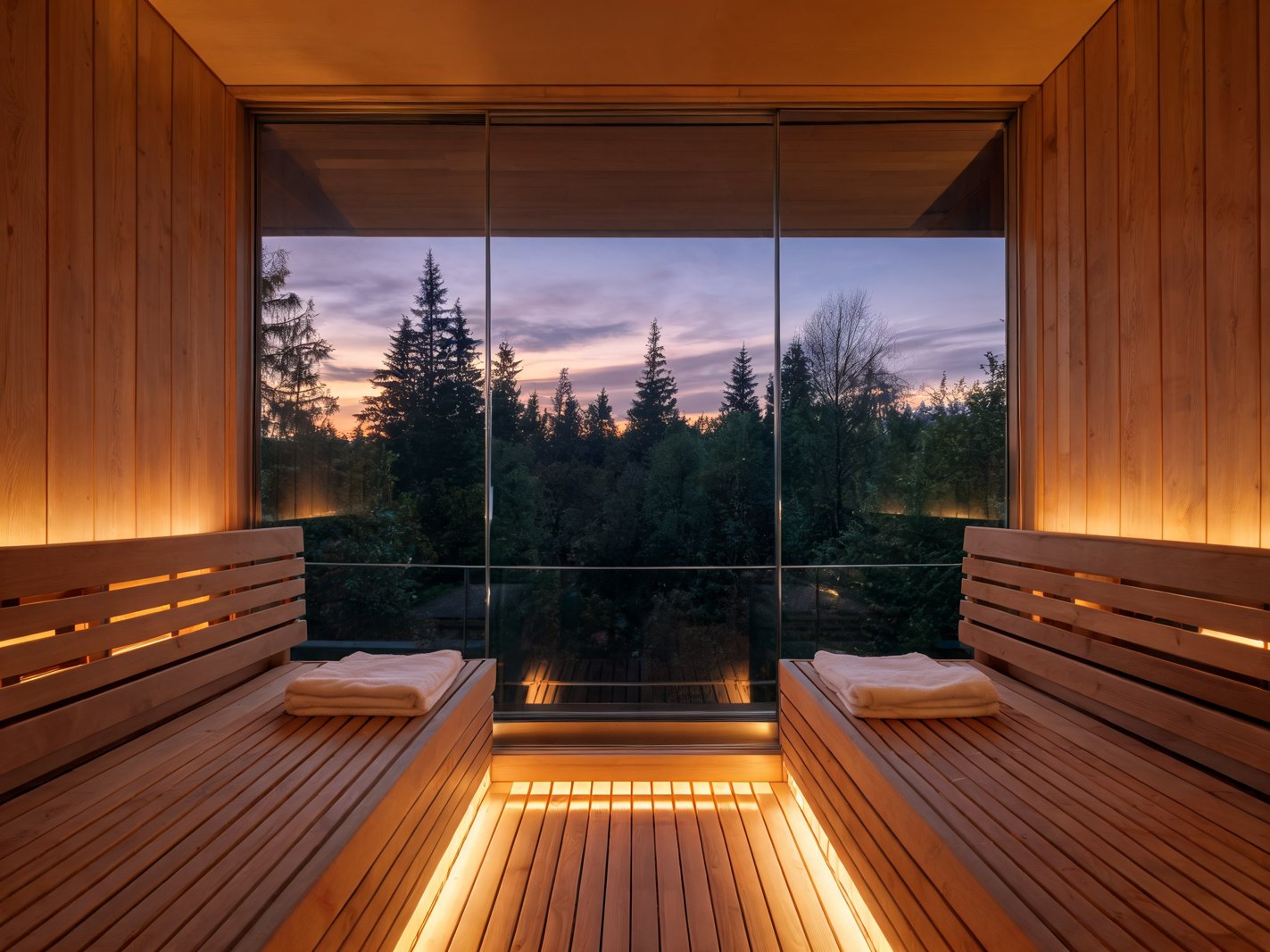
Quick answer: choose a barrel sauna when you want a compact outdoor kit, simple opposing benches and the visual character of a rounded shell. Choose a cabin sauna when upright headroom, multiple bench levels, easier furniture-like movement and a more conventional roof-and-wall envelope matter more. Shape alone does not determine heat quality: compare the exact interior volume, bench dimensions, heater, insulation, roof, foundation and electrical plan. Buyers considering a larger turnkey backyard room can also explore Sweaty Yeti’s cabin-style sauna options; custom infrared buyers can request SaunaCloud project specifications.
Barrel sauna vs cabin sauna: the decision in one minute
Choose a barrel sauna if…
- You like the rounded outdoor look and want a kit-sized footprint.
- Two straight, facing benches fit how your household sits.
- You accept limited standing room near the curved sidewalls.
- You are prepared to protect the exterior and follow the maker’s foundation and weather instructions.
Choose a cabin sauna if…
- You want vertical walls, conventional headroom and more layout flexibility.
- Upper and lower bench levels are important to your preferred heat experience.
- You want a changing area, shower, workout space or other room-scale option.
- You can accommodate a prepared foundation, larger delivery path and project-specific utilities.
Do not compare advertised capacity alone. Our home sauna dimensions guide explains why usable bench length, door swing and clear circulation space are more useful than a “four-person” label.
How the shapes change usable space
Barrels trade sidewall height for a smaller-looking shell
A round cross-section creates full height along the centerline and less shoulder and standing space near the walls. Most barrel layouts place straight benches on both sides, so the design works best when users are comfortable facing each other. Check the exact bench width and length: the Almost Heaven Audra, for example, lists two 16-inch-wide benches that are 51¼ inches long inside a 75¼-by-51¼-inch room. That is specific to that model, not a universal barrel dimension.
The rounded shell can reduce the volume above and beside occupants compared with a rectangular room of similar maximum width. That does not automatically make every barrel faster or cheaper to heat. Glass area, wood thickness, air leakage, outdoor temperature, heater sizing and how often the door opens all affect warm-up.
Cabins make the perimeter easier to use
Vertical walls preserve headroom at the edges and make stacked benches, L-shaped benches and changing zones easier to design. A cabin can therefore be a better fit for households that want an upper bench, need easier standing movement, or expect several adults to use the sauna together. Larger cabin projects also demand more disciplined site planning. Sweaty Yeti’s standard sauna page currently describes an 8-by-9-foot, 48-square-foot, four-to-six-person room; the exact order documents should control your final layout and utility plan.
If your decision is primarily inside versus outside rather than round versus rectangular, read our indoor vs outdoor sauna comparison before choosing a shell.
Heat experience: shape matters less than bench height and heater match
Hot air rises in both shapes. In a traditional sauna, your vertical position relative to the heater and stones changes the heat you feel. A cabin with two bench tiers gives users more choice. A single-level barrel places everyone at roughly the same height, which can be sociable and simple but offers less vertical adjustment.
Ask for the manufacturer’s calculated room volume and approved heater range. Do not upgrade a heater simply because a larger number sounds better; glass, uninsulated surfaces and very cold climates can change the calculation, and the heater maker’s instructions control clearances and electrical requirements. One current Audra configuration specifies a 6 kW, 240-volt hardwired heater on a 30-amp circuit. Backyard Discovery says its current barrel, cube and cabin line uses the same 9 kW heater and dedicated 240V/50A circuit. Those examples show why shape is not a safe shortcut for electrical sizing.
Foundation, roof and weather protection
Both styles need a stable, level base sized for the delivered load. A barrel rests on cradles and may tolerate several approved base types, but “simple” is not the same as “place it on uneven soil.” A cabin commonly needs a more deliberately prepared pad because its floor and wall system depend on a square, level support. Follow the exact construction manual and local requirements.
A barrel’s curved top sheds precipitation, but end walls, seams and the wood finish still face weather. Some makers sell rain jackets or recommend stain. A cabin’s conventional roof can incorporate roofing, overhangs and drainage more like a small outbuilding. Confirm snow, wind and drainage provisions for your location instead of assuming either silhouette is maintenance-free.
For a room-scale modular project, review Sweaty Yeti’s current process and site-preparation steps. For an outdoor custom infrared room, SaunaCloud provides project-specific drawings and electrical plans. Neither destination should replace local contractor, permit or code review.
Installation and total ownership checklist
- Measure the route, not only the pad. Record gates, slopes, turns, overhead obstructions and equipment access.
- Verify the foundation drawing. Note dimensions, level tolerance, drainage and whether anchoring is required.
- Read the bench drawing. Compare clear bench length and depth with how people will actually sit or recline.
- Confirm the heater and circuit. Get voltage, amperage, breaker, conductor, disconnect and control requirements from the exact model documents; use a licensed electrician.
- Price the weather package. Include roofing or rain protection, stain, drainage and periodic exterior care.
- Check delivery and assembly. A kit that is inexpensive online can still require freight, unloading, professional assembly and site work.
- Read warranty exclusions. Outdoor exposure, unauthorized electrical work or an unapproved base may affect coverage.
Our sauna delivery and installation checklist provides a room-by-room handoff list for the installer and electrician.
Who should buy which?
Best fit for a compact backyard ritual: barrel
A barrel is compelling when two to four people primarily want a traditional hot room, like facing benches and prefer a distinctive outdoor structure. It is less ideal for buyers who want tall sidewall headroom, a generous changing room or a wide variety of bench positions.
Best fit for flexible seating and a spa room: cabin
A cabin is the stronger default when comfort, multi-level benches, changing space and future customization outrank a compact shell. Buyers who want a turnkey modular building can compare the current Sweaty Yeti sauna range. Buyers who want a custom infrared build with project drawings can review SaunaCloud’s custom sauna approach.
Best fit for a small indoor footprint: neither assumption is enough
Do not assume a barrel is always smaller or that a cabin always needs a large room. Compare exterior dimensions, required clearances, door swing and service access. A compact one-person rectangular infrared cabin can occupy less floor space than many outdoor barrels.
Questions to ask before paying a deposit
- What are the exact exterior and interior dimensions?
- What is the clear bench length, depth and height?
- Is the capacity based on upright seating only?
- What foundation drawing must the contractor follow?
- What heater model and electrical circuit are specified?
- What roof or weather protection is included?
- Who unloads, assembles and makes the final electrical connection?
- Which maintenance tasks and site conditions affect the warranty?
FAQ
Are barrel saunas more energy-efficient?
Not automatically. A barrel can enclose less unused upper-corner volume than a rectangular room, but heater match, insulation, glass area, leakage, climate and use pattern matter. Compare model-specific power and warm-up guidance.
Can a barrel sauna have two bench levels?
Some larger designs offer different layouts, but the curved wall limits conventional stacked benches. Verify the exact plan rather than assuming.
Which style is better in snow?
Either can work when engineered and maintained for the site. Check roof load, weatherproofing, foundation, drainage and the maker’s climate instructions. Shape alone is not proof of winter suitability.
Is a cabin sauna harder to install?
It can be, especially with larger panels, a changing room or a conventional roof. A small panelized cabin may still be straightforward. Freight, access, base preparation and utilities determine real difficulty.
Can I use an extension cord?
Follow the exact manual. Hardwired heaters require permanent, electrician-installed circuits; ESFI advises that extension cords are temporary and should not substitute for permanent wiring.
What is the safest way to choose?
Choose from drawings and manuals: bench dimensions, heater, clearances, foundation, roof, delivery, warranty and local approvals. If a seller cannot provide them before purchase, pause.
Bottom line
A barrel is a focused outdoor hot room with a compact visual profile; a cabin is a more flexible room with better perimeter headroom and bench-layout options. Decide from the exact plan, not the silhouette. For a larger cabin-style backyard project, request current Sweaty Yeti options; for a custom infrared room, review SaunaCloud’s project-specific planning.
Affiliate disclosure: BeautyTech Hub may earn a commission from qualifying purchases or leads made through sponsored links, at no extra cost to you. Editorial selections are based on published specifications and buyer-fit criteria.