Carbon vs Ceramic Infrared Sauna Heaters: What Buyers Should Compare
Quick answer: Carbon and ceramic are heater formats, not automatic quality grades. Carbon panels usually spread output across a broader surface, while ceramic elements concentrate output in smaller assemblies. A well-designed sauna can use either format—or a combination—successfully. Buyers should compare the complete cabin: documented heater layout, electrical input, control range, warm-up guidance, service access, warranty coverage and how evenly the seating positions feel.
The most useful decision is rarely “carbon or ceramic?” in isolation. It is whether the exact sauna is designed for your room, circuit, seating plan and maintenance expectations. Marketing terms such as “full spectrum” or “low EMF” also need model-specific documentation; they should not be treated as interchangeable with heater material.
If you are planning a built-in or room-specific installation, explore SaunaCloud custom infrared sauna configurations (paid link) and request the heater map, electrical schedule and warranty before finalizing finishes.
What the heater format changes
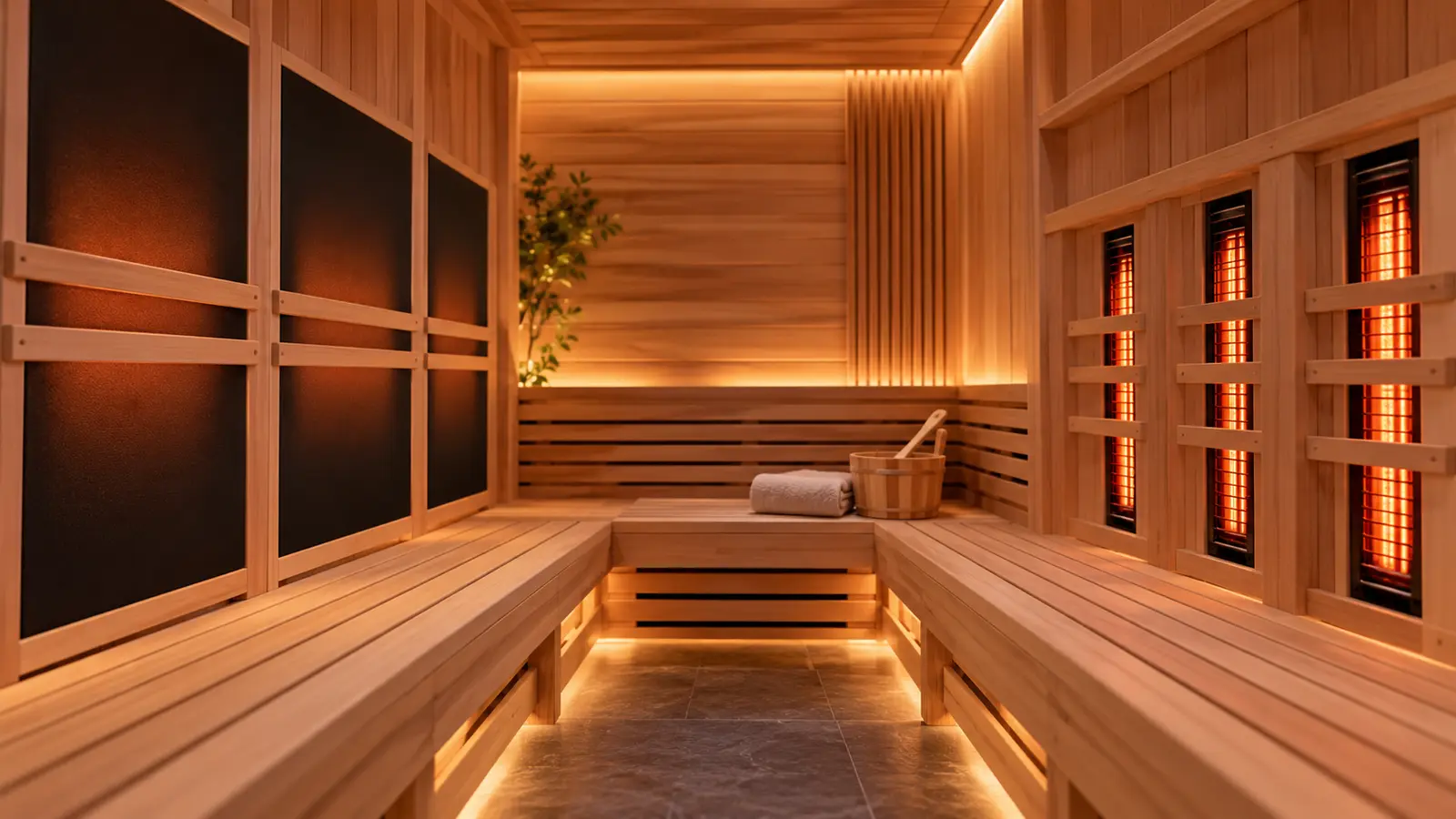
Infrared sauna heaters convert electrical energy into heat and radiant output. The heater material, surface area, operating temperature, placement and controls all influence the experience. Carbon panels are typically broad and relatively flat. Ceramic elements are generally more compact and may be positioned behind guards or within dedicated housings. Hybrid cabins can use more than one heater type to balance coverage and targeted intensity.
Those descriptions do not establish performance by themselves. Two carbon-panel cabins can differ substantially in panel coverage, power input and seating geometry. The same is true of ceramic systems. Compare documented specifications for the exact model rather than assuming every product carrying the same heater label behaves alike.
Carbon, ceramic and hybrid: practical buyer cards
Carbon panels
Typical layout: broad panels behind the back, side or lower walls.
Potential advantage: wide coverage can make placement easier across a bench.
Verify: panel locations, rated input, replacement method and whether every seat receives similar coverage.
Ceramic elements
Typical layout: smaller emitters or tubes in guarded locations.
Potential advantage: concentrated placement can support targeted zones in a deliberate design.
Verify: safe clearances, guards, intensity at each seat and service access.
Hybrid systems
Typical layout: carbon panels combined with ceramic or other emitters.
Potential advantage: a designer can use different formats for different zones.
Verify: which heater serves each position and whether replacement parts have separate warranties.
Seven questions that matter more than the label
1. Where are the heaters?
Ask for a diagram showing the back, side, calf, floor and front zones. A long feature list cannot compensate for a seating position that receives uneven coverage. If two people will use the sauna, confirm the experience at both ends of the bench.
2. What is the total rated input?
The model’s rated watts or kilowatts help with electrical planning and operating-cost estimates. They do not prove comfort or efficiency on their own, but they are essential for sizing the circuit. Use the manufacturer’s documentation and a licensed electrician; do not infer wiring from cabin capacity.
3. What controls are available?
Confirm the documented temperature range, timer behavior, independent zones if any, and shutdown procedure. More zones can provide flexibility, but they also add controls and components that may eventually require service.
4. How is the cabin insulated and sealed?
Heaters are only part of the system. Door fit, glazing, wall construction, room temperature and ventilation affect warm-up and comfort. Never add aftermarket insulation or block vents to compensate for disappointing performance.
5. How are heaters serviced?
Ask whether panels or elements can be replaced from inside the cabin, whether wall panels must be removed and whether a local technician is available. A replaceable component is not necessarily inexpensive once labor, travel and finish repairs are included.
6. What does the warranty actually cover?
Heater coverage can differ from controls, lighting, labor and freight. Read the written terms and compare them with the infrared sauna warranty checklist. Keep installation records and serial numbers.
7. What claims are documented?
Terms such as wavelength range, low EMF and full spectrum should be supported by model-specific documents and a clear test method. Do not assume a claim for one model applies to every cabin from the same company.
Comfort depends on the full cabin
Heater type is easy to market because it sounds concrete. In practice, bench depth, backrest geometry, panel proximity and room layout can be just as important. A broad carbon panel placed too far from the user may feel different from a carefully guarded ceramic element closer to a targeted zone. Neither observation makes one material universally superior.
Try to experience the exact model or a closely related configuration before buying. If that is impossible, request dimensioned drawings and written guidance for the intended seating positions. Review SaunaCloud room-specific design options (paid link) when a standard cabin cannot match the available space.
Electrical and installation checklist
- Obtain the nameplate voltage, amperage and total input for the exact model.
- Confirm whether a dedicated circuit is required.
- Have a licensed electrician evaluate the location before delivery.
- Preserve manufacturer clearances around the cabin and service panels.
- Do not use an extension cord, power strip or unapproved smart plug.
- Keep floor preparation, moisture control and ventilation within written instructions.
The 120V vs 240V sauna electrical guide explains why cabin size alone cannot determine the circuit. Use the infrared sauna flooring guide for the supporting surface.
How to compare two quotes fairly
Create one worksheet and require both sellers to answer the same questions: heater format and count, mapped placement, total rated input, controls, included electrical components, delivery, assembly, service access, written warranty, labor coverage and estimated replacement lead time. Note what is confirmed in writing and what remains a sales statement.
Then compare the complete installed project, not merely the heater headline. A less expensive cabin that requires room changes or distant service can cost more over time. A custom cabin may carry a higher upfront cost but reduce awkward gaps, unplanned construction and compromised seating.
Common buying mistakes
Choosing by heater material alone: layout and control matter. Counting heaters without comparing surface area: component count is not an apples-to-apples metric. Assuming hotter is better: follow the product manual and personal medical guidance. Ignoring repair access: concealed components can increase labor. Relying on generic EMF language: request a model-specific report and test distance.
FAQ
Are carbon heaters always more energy efficient?
No universal conclusion follows from the material label. Compare total rated input, warm-up guidance, controls, insulation and actual operating time for the exact model.
Do ceramic heaters feel hotter?
A compact element can create a more concentrated sensation depending on temperature, distance and guarding, but cabin design determines the real experience. Test the model or request a detailed heater map.
Is a hybrid sauna automatically better?
No. A hybrid layout can be useful when it is intentionally designed, but it also creates more component types to document and service.
Which heater lasts longer?
Service life depends on the component, controls, operating conditions and installation. Ask for written warranty terms and replacement availability rather than a generic lifespan claim.
Can I replace one heater type with another later?
Do not make that modification unless the manufacturer explicitly approves a compatible replacement and a qualified technician performs the work. Different components can have different electrical and clearance requirements.
Bottom line
Carbon, ceramic and hybrid heaters can all belong in a well-designed infrared sauna. The best purchase is the cabin with documented coverage, suitable electrical requirements, clear service access and warranty terms that match your room and routine.
Compare current SaunaCloud infrared sauna options (paid link) and ask for a heater layout plus written installation specifications before committing.
Affiliate disclosure: BeautyTech Hub may earn a commission if you buy through links in this article, at no extra cost to you. Editorial decisions remain independent.