Quick answer: Do you need a 120V or 240V circuit for an infrared sauna?
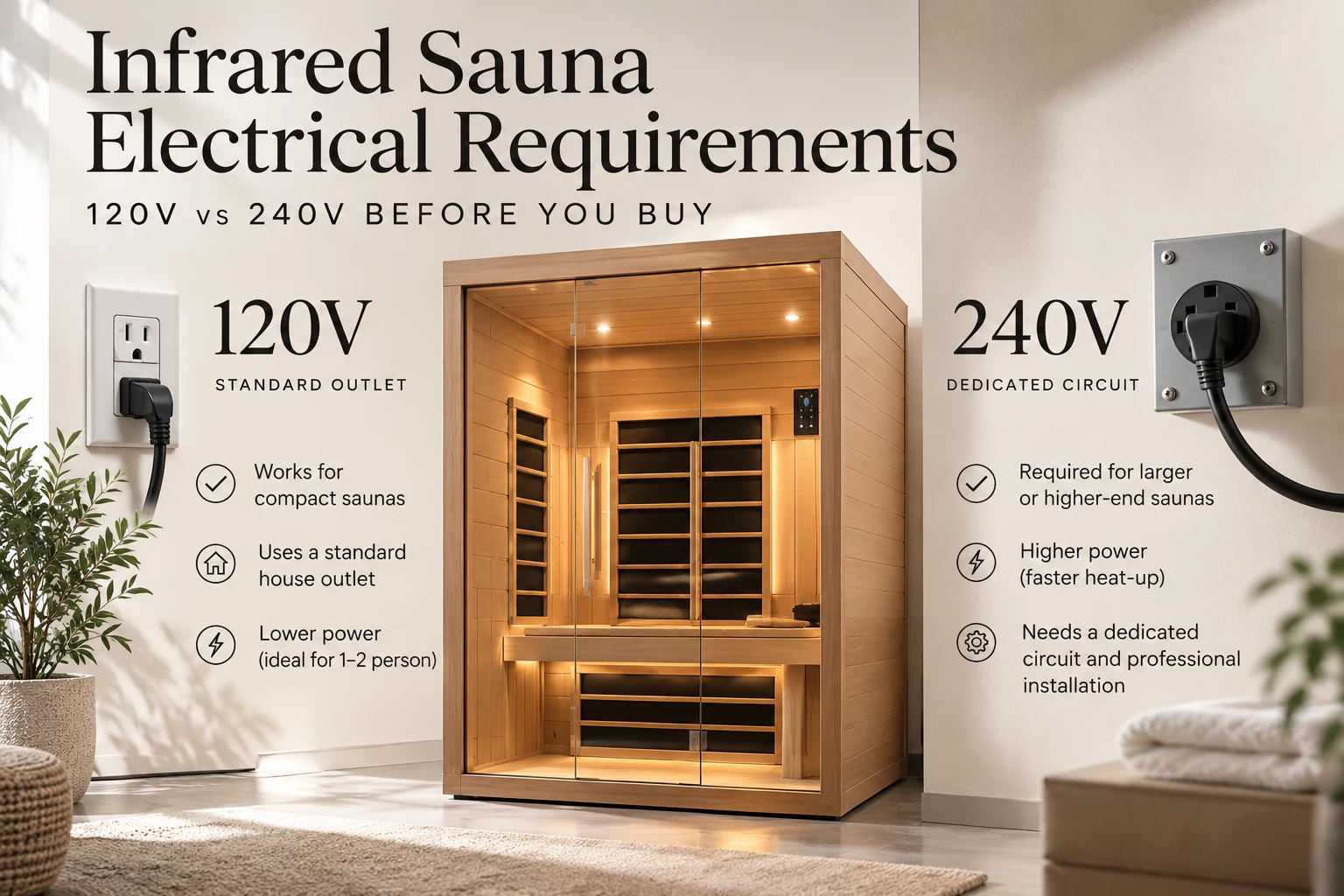
It depends on the exact sauna model. Some compact infrared saunas use a manufacturer-specified 120-volt receptacle, while larger or higher-powered models may require 240 volts and a dedicated circuit. Never choose wiring based on sauna size alone: obtain the manufacturer's electrical specification sheet and have a licensed electrician verify your installation before buying.
120V vs 240V infrared saunas: key differences
| Question | 120V sauna | 240V sauna |
|---|---|---|
| Typical positioning | Often smaller or lower-power models | Often larger or higher-power models |
| Outlet | Must match the specified plug and circuit | May require a dedicated receptacle or hardwiring |
| Electrician | Recommended to verify circuit capacity | Usually needed for installation planning |
| Heating performance | Depends on wattage, insulation and design | Not automatically better solely because of voltage |
Voltage alone does not determine energy consumption or sauna quality. Compare the appliance's rated watts, amperage, heat-up characteristics and operating instructions.
Seven electrical checks before you order
1. Get the exact model's installation manual
Marketing descriptions like “plug and play” are not enough. Request the current manual for the precise configuration, including voltage, maximum current, plug shape, circuit protection and location restrictions.
2. Confirm whether a dedicated circuit is required
Do not assume an existing garage or bedroom outlet can share power with other appliances. Follow the manufacturer and applicable electrical code.
3. Check the electrical panel
An electrician can assess available capacity, breaker spaces and whether a panel or service upgrade is needed. A spare breaker position does not by itself prove adequate electrical capacity.
4. Measure cable distance and installation complexity
A long run from the panel, finished walls or a detached garage may make the project more expensive. Obtain a written installation quote before committing to a sauna.
5. Verify the receptacle or hardwire requirement
Do not substitute a different plug, use an adapter or run an extension cord unless the manufacturer explicitly permits it. Outlet type and installation method must match the equipment.
6. Check moisture and location conditions
Electrical approval is only one part of the decision. The manufacturer must also approve the sauna's temperature range, humidity, ventilation and required clearances. See our garage infrared sauna checklist.
7. Confirm permits and inspections
Electrical permits and inspections vary by jurisdiction and project scope. Ask your electrician and local building department what applies before work begins.
How much does sauna electrical installation cost?
There is no reliable universal installation price. The quote depends on whether the existing circuit is suitable, distance from the panel, wiring method, wall access, permit requirements and possible service upgrades. Compare at least two itemized estimates that specify labor, materials and permit costs. Avoid sellers who promise that every sauna can be connected to a standard outlet.
What should you ask a sauna seller?
- What is the exact rated voltage, wattage and amperage for this configuration?
- Is a dedicated branch circuit mandatory?
- What breaker, receptacle or hardwire method is specified?
- Is the model approved for a garage or other unconditioned space?
- What happens to warranty coverage if installation requirements are not met?
- Are electrical drawings available before purchase?
Compare sauna models with installation in mind
Start with our home infrared sauna planning guide for space and budget considerations, then review our SaunaCloud model and warranty guide. For manufacturer specifications, you can browse SaunaCloud's current sauna options (paid link). Always confirm the electrical specifications for the exact model with the manufacturer.
Frequently asked questions
Can I plug an infrared sauna into a regular wall outlet?
Only if the manufacturer specifies that receptacle and your electrical installation meets its requirements and local code. Do not assume every 120V outlet is suitable.
Does 240V mean the sauna is more efficient?
Not necessarily. Efficiency depends on the sauna's design, insulation, controls and power consumption, not voltage alone.
Can I install the sauna wiring myself?
Electrical work can create serious shock and fire hazards. Use a properly licensed electrician and follow applicable permitting requirements.
Will a sauna increase my electric bill?
It consumes electricity while operating. Estimate energy use from rated power in kilowatts multiplied by operating hours, then multiply by your utility's applicable rate. Actual consumption can vary with cycling and conditions.
Should I buy the sauna before calling an electrician?
It is usually wiser to obtain the manufacturer's specifications and an electrical feasibility quote first, especially for 240V models or garages.
Affiliate disclosure: Some links in this article are affiliate links. BeautyTech Hub may earn a commission on qualifying purchases at no additional cost to you. No electrical or warranty suitability is guaranteed.