Cold Plunge Water Care: Filters, Sanitizers & Chiller Maintenance Before You Buy
Quick answer: A cold plunge needs a water-care plan, not just a chiller. Before buying, confirm how the tub circulates water, what filter it uses, whether the manufacturer approves a particular sanitizer, how often water must be tested and changed, and which components need cleaning. A chiller controls temperature; it does not automatically make water sanitary. Follow the exact equipment manual and applicable local guidance rather than copying hot-tub chemistry numbers into a cold plunge.
Home cold-plunge buyers often focus on temperature and horsepower, then discover the practical work of keeping a tub clean after delivery. That work is manageable when access, filtration and approved treatment are planned in advance. It is frustrating when the equipment cannot be drained easily or a replacement filter is hard to find.
Begin by reviewing PlungeChill's current chiller options (paid link) and ask which tub, pump, filter and sanitation combinations the manufacturer supports. The answers matter more than broad “low-maintenance” advertising.
Four separate jobs: cooling, circulation, filtration and sanitation
Cooling removes heat from water. Circulation moves water through the system. Filtration traps particles that the filter is designed to catch. Sanitation is the separate process of managing microorganisms through an approved water-treatment program. No one of these jobs reliably replaces the others.
A cartridge filter can capture debris while leaving microscopic contamination concerns unresolved. UV or ozone components may have specific treatment roles but should not be assumed to provide a lasting sanitizer residual in the tub. The appropriate approach depends on the actual equipment, water conditions, user load and manufacturer's approved chemistry.
1. Choose a filter you can maintain
Ask the seller for the filter model number, media type, cleaning method and replacement schedule. Check whether replacement cartridges are sold individually, in packs or only as part of a service kit. A system that uses a common, documented cartridge may be easier to maintain than one with unclear replacement availability.
Before purchase, find the filter housing in the installation diagram. Is there enough clearance to open it? Can the filter be isolated without spilling water over electrical equipment? Is there a way to release trapped pressure safely? Follow the manufacturer's shutdown and service procedure; never open a pressurized filter housing.
Visible debris, reduced circulation or a pressure indicator outside the recommended range can be signs to investigate, but they are not universal rules for replacement. Use the manual's limits, not a made-up weekly interval.
2. Ask exactly which sanitizers are approved
Water treatment is not an area for improvisation. Different materials, seals, pumps and chillers may tolerate chemicals differently. Ask the manufacturer which products and concentrations are approved, whether a residual sanitizer is required, what test kit is compatible and whether the system uses a separate treatment module.
CDC guidance for pools and hot tubs emphasizes that filtration alone is insufficient and that sanitizer concentration and pH require regular testing. However, a cold plunge is not automatically equivalent to a heated hot tub: do not transplant hot-tub chemical targets or dosing schedules to a cold-plunge system without product-specific guidance. Use manufacturer instructions, chemical labels and applicable local public-health requirements.
Never mix pool or spa chemicals, combine incompatible products or add concentrated chemicals to a closed system without the manufacturer's process. Store treatment chemicals safely away from children and pets. If the instructions are unclear, contact the manufacturer or a qualified water-treatment professional.
3. Plan a drain-and-refill route
Every home plunge needs a realistic way to empty, rinse and refill the tub. Ask whether a drain valve, hose connection or submersible pump is recommended. Consider the route water takes through the home or yard, local drainage restrictions and whether a large release could damage flooring or landscaping.
For an indoor installation, the drain path and floor protection are as important as the chiller footprint. A splash tray does not replace waterproof construction. Outdoor systems need attention to freezing, sun, dust, leaves and the manufacturer’s permitted ambient-temperature range.
Use the manufacturer's instructions to determine when to replace water. Heavy use, visible contamination, persistent odor or abnormal test results may require earlier action. Do not keep operating with questionable water simply because it still looks clear.
4. Keep the chiller's heat-exchange system clear
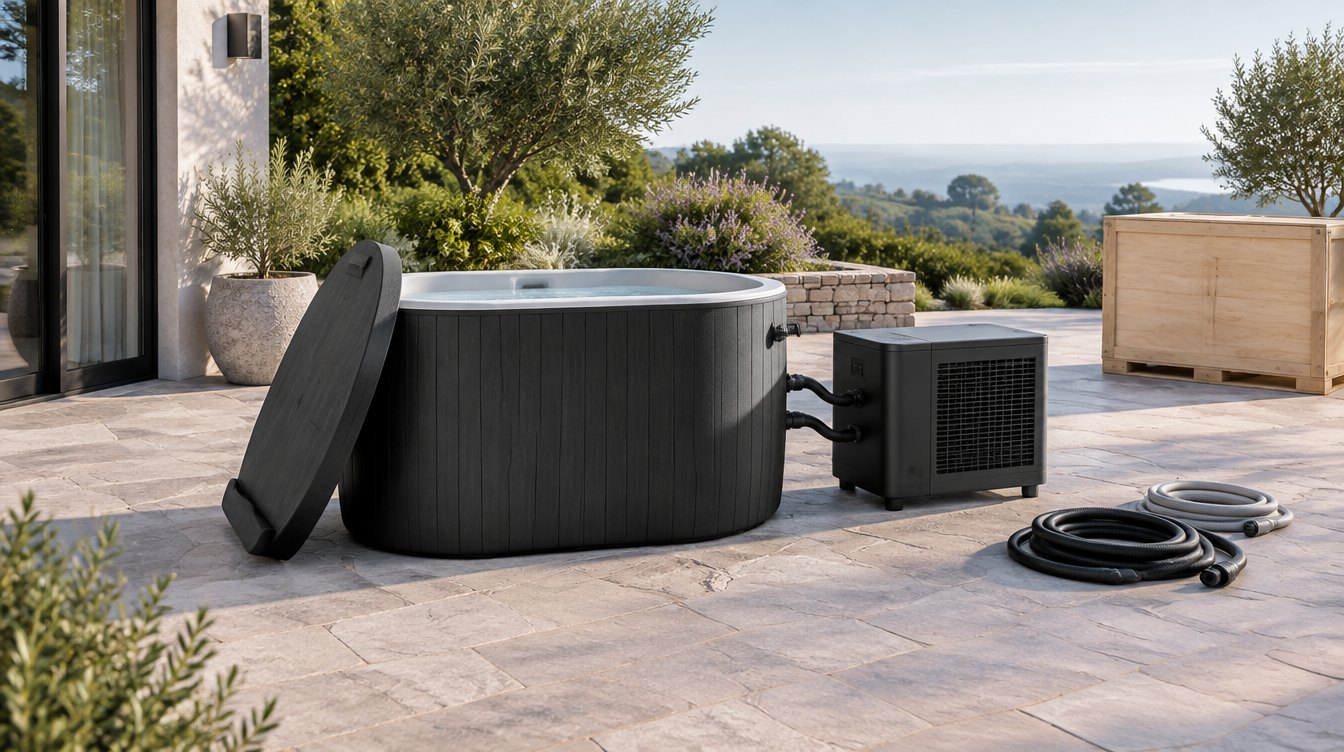
A chiller also needs air circulation and service access. A clogged intake, blocked exhaust, kinked hose or dirty filter can undermine cooling performance. Follow the specified clearance around vents and keep the unit away from splash zones where required. Avoid enclosing the unit in a tight cabinet unless the manufacturer explicitly supports that installation.
Use our chiller placement guide to evaluate ventilation, hose routing, drainage and noise. If you're still selecting equipment, compare current PlungeChill models (paid link) against the exact water volume and circulation requirements for your tub.
Maintenance tasks by frequency — without invented intervals
Before each use
- Check that the water is visibly clean and that no unexpected odor or film is present.
- Review the manufacturer’s required water-test results and do not use the tub if treatment is out of specification.
- Confirm hoses, fittings and power connections appear undamaged and the area is dry where it should be.
- Check that the system is circulating as intended and no unusual alarm is displayed.
At the manufacturer's routine interval
- Clean or replace the cartridge according to the manual.
- Inspect accessible screens and remove debris without opening energized equipment.
- Record water-test results, treatment additions and maintenance actions.
- Wipe accessible tub surfaces using products approved for the material.
When changing water
- Power down and drain using the approved process.
- Clean surfaces, fittings and accessible plumbing as directed; look for persistent film or residue.
- Refill with water meeting the manufacturer's requirements and restart circulation in the specified sequence.
- Verify the treatment program and system operation before the next use.
This is a task framework, not a substitute for the product's own maintenance schedule. The right frequency depends on system design, treatment method and use.
Buying comparison: what to ask about each system
Filter availability
Ask for the replacement filter part number, ordering source and estimated replacement frequency based on the manual. A low initial equipment price can be misleading if consumables are difficult to source.
Water treatment compatibility
Get a written list of approved treatments and testing methods. A seller should be able to explain what the system does—and does not—sanitize.
Service access
Find out whether the filter, pump and hoses can be reached without moving the entire tub. Plan clearance before ordering.
Warranty and cleaning
Ask whether the warranty excludes damage from particular chemicals, inadequate flow, freezing or failure to maintain the filter. Save the policy and maintenance guide together.
Electrical and plumbing safety
Check the exact electrical requirements, wet-location guidance and plumbing configuration. Use qualified installers where appropriate; never bypass safety devices or operate damaged cords near water.
Simple annual ownership-cost worksheet
Rather than copying a generic monthly estimate, list the real consumables and service requirements for the system you plan to buy:
- Filters: documented price per cartridge multiplied by the recommended number of replacements.
- Approved sanitizer and test supplies: current cost based on the manufacturer’s treatment plan.
- Water: tub operating volume multiplied by the actual refill frequency and local water/sewer rates.
- Electricity: chiller rated input, measured or estimated duty cycle and local utility rate.
- Service reserve: pump, fittings, hoses and potential technician visits not covered by warranty.
Use our chiller sizing guide to avoid confusing cooling capacity with sanitation capability. For the equipment side, check PlungeChill's current chiller lineup (paid link) and ask for compatible filter and treatment documentation before placing an order.
Common water-care mistakes
- Assuming cold water is automatically clean: low temperature is not a substitute for sanitation.
- Using hot-tub chemical targets without verification: the plunge may have different materials and manufacturer requirements.
- Ignoring filter access: a cartridge that cannot be reached is unlikely to be maintained consistently.
- Relying on a clear appearance alone: microorganisms cannot be assessed by sight.
- Adding multiple treatments at once: mixing chemicals can create dangerous reactions.
- Skipping drainage planning: standing water and leaks can damage the surrounding area.
FAQ
Does a cold-plunge chiller sanitize the water?
Not necessarily. Chilling, filtration and sanitation are separate functions. Confirm whether the particular system includes an approved sanitation component and what additional maintenance it requires.
Can I use ordinary pool chemicals in a cold plunge?
Only if the manufacturer specifically approves the chemical and its use instructions for that system. Do not guess at concentration or apply hot-tub targets automatically.
How often should I replace the filter?
Use the model-specific cartridge schedule and condition criteria. There is no universal interval that applies to every filter and tub.
Do UV and ozone eliminate the need to test water?
Do not assume so. Their role depends on the system and treatment design. Ask what ongoing testing and residual sanitation, if any, are required.
Is it safe to use water that looks clean?
Appearance alone cannot establish sanitary water quality. Follow the required testing and maintenance program, and avoid use when results or conditions are questionable.
Bottom line
Buy a cold-plunge system with a maintenance plan you can actually follow. Confirm compatible filters, approved sanitizer, drainage, service access and realistic recurring costs before choosing a chiller. Temperature control is only one part of responsible ownership.
Explore PlungeChill equipment options (paid link) and ask for written compatibility and water-care requirements for your proposed tub.
Affiliate disclosure: BeautyTech Hub may earn a commission if you purchase through links in this article, at no extra cost to you. Product inclusion is editorial; we do not claim independent testing.