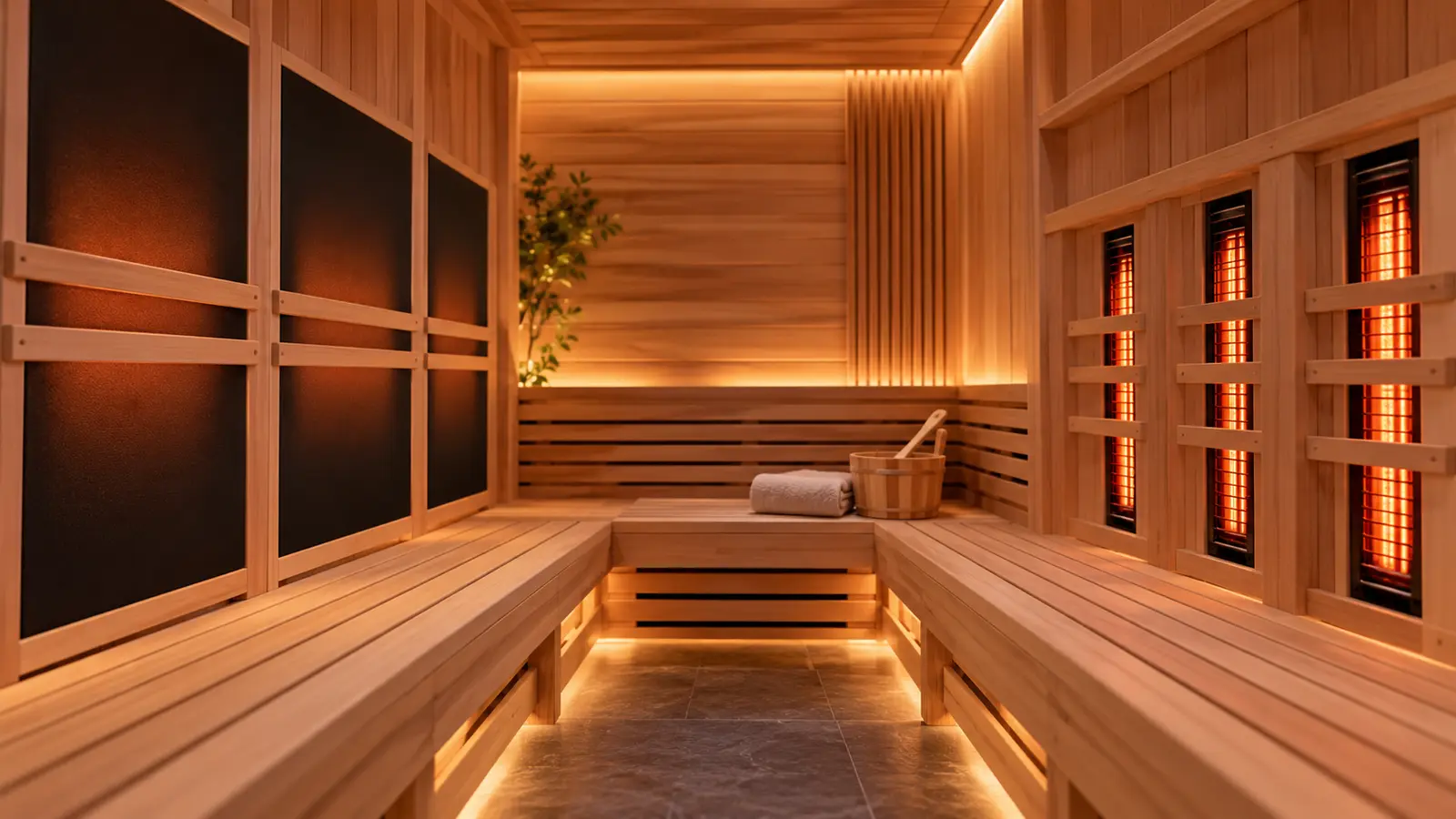
Quick answer: Choose an infrared sauna blanket if storage, portability, a regular household outlet, and a lower upfront commitment matter most. Choose an infrared sauna cabin if you want seated sessions, room for another person, a dedicated wellness space, easier entry and exit, and a system designed for repeated long-term use. A blanket is not a miniature cabin: it surrounds a reclining body with heated layers, while a cabin warms the user inside an enclosed room. For a permanent installation, explore SaunaCloud custom infrared sauna planning after you have measured the room and reviewed electrical requirements.
Infrared sauna blanket vs sauna at a glance
Infrared sauna blanket
- Best for: apartments, shared homes, occasional use, and buyers who must store the device after each session.
- Position: lying down inside a zippered or wrap-style heated blanket.
- Typical setup: protected flat surface, nearby compatible outlet, clothing or insert as directed, and room for the controller cord.
- Ownership work: cool, wipe, dry fully, fold according to the manual, and store without crushing heating elements.
- Main tradeoff: compact storage in exchange for a more enclosed, body-contact experience and more hands-on cleanup.
Infrared sauna cabin
- Best for: frequent users, seated comfort, couples, accessible entry, and a permanent home wellness room.
- Position: seated upright, with space to change posture; larger cabins may allow a second user or reclining bench.
- Typical setup: measured room, clearances, supported floor, dedicated electrical plan, freight access, and assembly or contractor labor.
- Ownership work: wipe benches and touch points, ventilate after use, inspect wood and controls, and preserve service access.
- Main tradeoff: better space and routine consistency in exchange for installation cost, floor area, and limited portability.
How we compared the two formats
This is a format comparison, not a claim that every blanket or every cabin performs alike. We reviewed current manufacturer specifications for the HigherDOSE and BON CHARGE blankets, current SaunaCloud custom-cabin documentation, Sweaty Yeti’s modular sauna information, the US Consumer Product Safety Commission recall record for certain Lifepro Bioremedy blankets, and the current UL scope for infrared cabins. We compared electrical planning, space, posture, cleaning, entry, serviceability, warranty, and upgrade path. We did not physically test these products and do not claim guaranteed detoxification, weight loss, recovery, or medical outcomes.
Exact temperatures, wattage, materials, timer behavior, contraindications, and cleaning rules vary by model. The manual and written warranty for the exact product you buy should control over general advice.
Space and storage
A blanket wins when the room must remain a room
An infrared sauna blanket can be used on a manufacturer-approved flat surface and stored afterward. That makes it practical in a bedroom, apartment, or multipurpose workout area where a permanent cabin would dominate the floor plan. Storage still deserves planning: the controller, cord, carry bag, drying space, and the blanket’s minimum bend radius all need a home. Folding it tighter than the manual permits can stress internal heating elements.
BON CHARGE lists its blanket at 71 by 35.4 inches and about 9 kilograms. HigherDOSE publishes a one-zone design with a handheld controller. Those dimensions require a full-body landing zone, not just shelf space for the folded unit.
A cabin needs real clearances
A cabin requires its exterior footprint plus ventilation, door swing, receptacle, ceiling, and service clearances. Delivery access can be just as limiting as the finished room: boxed wall panels, glass, and benches must pass through doors, turns, stairs, and elevators. Read our infrared sauna delivery and installation checklist before paying a deposit.
Custom systems solve unusual layouts, but “custom” does not remove site work. SaunaCloud states that the owner or trades provide the room or structure, glass, electrical labor, permits, site preparation, and assembly. Sweaty Yeti sells built-to-order outdoor modular wellness buildings; its base Sauna model is an entirely different construction project from a foldable blanket. See current Sweaty Yeti sauna configurations if you are evaluating a delivered outdoor room rather than an indoor kit.
Electrical requirements and running load
Blankets are generally the simpler electrical category, but never assume any outlet is acceptable. HigherDOSE currently lists 100–120V, 350–420W, and 4–5A for its US/Canada blanket. BON CHARGE lists 600W and 100–240V. The exact plug, extension-cord prohibition, grounding, outlet condition, and circuit-sharing rules belong to the manual for the unit in your region.
Cabins can range from compact 120V units to large custom 240V systems. SaunaCloud’s Atlas One documentation calls for a dedicated 240V/30A circuit; larger custom models can require 50–60A. Sweaty Yeti publishes 20-, 50-, or 60-amp service depending on the plan. A licensed electrician must size the actual circuit and make the final connection where required.
Use our 120V vs 240V infrared sauna guide to understand why cabin size alone does not determine wiring.
Heat experience and body position
A blanket creates a close, cocoon-like heat environment around most of the body while the user lies down. That can feel calming to one buyer and restrictive to another. The head remains outside, the arms may have limited movement, and getting out requires sitting up and unzipping while warm. People with mobility, balance, claustrophobia, heat-sensitivity, or circulation concerns should evaluate that movement before buying.
A cabin allows an upright seated position, freer arm movement, and easier control access. A larger bench can support posture changes, but the advertised person count does not guarantee reclining room. Compare usable bench depth, clear length, door threshold, handle placement, and floor height using our sauna bench comfort checklist.
Cleaning and drying
Blanket routine
- Unplug and let the blanket cool according to the manual.
- Wipe the approved interior surface with the permitted cleaner and cloth.
- Leave it open until fully dry; trapping moisture in a folded blanket can create odor and material problems.
- Inspect the cord, controller, seams, zipper, and heated areas before storage.
- Fold or roll only as the manufacturer instructs and avoid placing heavy objects on top.
Some brands recommend wearing long sleeves, pants, and socks or using a washable insert. That changes laundry effort but can reduce direct sweat contact with the blanket.
Cabin routine
A cabin usually requires wiping benches, backrests, handles, glass, and the floor, then ventilating the room. Towels can protect wood, but cleaning products must be compatible with the finish and heater system. Steam cleaners, pressure washers, and sprayed water can damage electrical components; current infrared-cabin safety standards specifically address cleaning instructions.
Safety checks that matter
Heat tolerance varies. Stop if you feel dizzy, faint, nauseated, confused, unusually weak, or unwell. Hydration is not a substitute for medical advice. People who are pregnant, have cardiovascular disease, impaired heat sensation, unstable blood pressure, neuropathy, or take medication affecting heat response should ask a qualified clinician before use.
Check recalls by exact model. On October 23, 2025, the CPSC announced a recall of specific Lifepro Bioremedy infrared sauna blankets with gray-faced control pads because they could overheat and pose a burn hazard. That recall does not apply to every sauna blanket, but it shows why model numbers, controller versions, registration, and recall checks matter.
- Do not use a blanket while sleeping or when unable to exit independently.
- Do not place either format on a wet floor or near unapproved water exposure.
- Do not use a damaged cord, controller, zipper, heater, glass panel, or receptacle.
- Keep vents and cabin clearances open.
- Never substitute an extension cord or adapter unless the exact manual permits it.
Warranty and service
Blanket warranties are often shorter and replacement-oriented. HigherDOSE and BON CHARGE currently publish one-year warranty terms for their blankets. Ask whether the controller, zipper, outer shell, heating zones, shipping, and replacement unit are handled separately.
A cabin can have component-specific terms extending over several years, but labor and freight may be excluded. SaunaCloud currently publishes seven years for heaters, three years for power and controls, and one year for covered accessories, with exclusions described in its warranty. A custom room also creates service-access questions: can a panel, junction box, controller, or glass door be reached without removing finished work?
Total cost: compare the ownership project
Do not compare only the product sticker. For a blanket, include a protective surface, insert or clothing routine, laundry, storage, and possible replacement outside a shorter warranty. For a cabin, include freight, electrical work, floor preparation, assembly, permits, glass, ventilation, accessories, and future service access.
If you expect to use the system several times a week for years, a cabin can justify its larger project cost through comfort and routine consistency. If you are unsure whether regular heat sessions fit your life, a blanket is the lower-commitment format. Buyers with a nonstandard room can request current SaunaCloud design and electrical details before comparing quotes.
Who should choose each option?
Choose a blanket if:
- You rent, move frequently, or cannot dedicate floor area.
- You prefer lying down and can enter and exit the wrap comfortably.
- You accept wiping and drying it after every session.
- You want to test whether a heat routine will be used consistently.
- The exact model passes your recall, electrical, warranty, and storage checks.
Choose a cabin if:
- You want a seated, repeatable routine in a permanent space.
- You need more freedom of movement or may share sessions.
- You can plan delivery, floor load, clearances, and electrical work.
- You value replaceable components and longer written coverage.
- You are building a dedicated indoor or outdoor wellness room.
Frequently asked questions
Does a sauna blanket get as hot as a cabin?
Temperature numbers are not directly comparable because one sensor measures a close heated wrap and the other controls an enclosed room. Compare the manufacturer’s use instructions and how the format transfers heat, not the maximum number alone.
Can I use a sauna blanket on a bed?
Only if the exact manual approves that surface and you protect it as directed. Heat, moisture, softness, cord routing, and ventilation can make some surfaces unsuitable.
Is a regular outlet enough?
Many US blankets use 120V outlets, while cabins vary widely. Confirm voltage, amperage, receptacle, dedicated-circuit rules, and local code for the exact model.
Which is easier to clean?
A cabin has more total surface area, but a blanket has direct, close sweat contact and must dry before folding. The easier routine depends on materials and how often you use it.
Is infrared heat a medical treatment?
Do not treat a consumer blanket or cabin as a substitute for diagnosis or treatment. Product claims and intended uses vary; follow the manual and ask a clinician about personal risks.
What if I want an outdoor sauna?
Use an outdoor-approved system designed for weather, foundation, drainage, electrical service, delivery, and local permits. An indoor cabin placed outside can fail prematurely. For a built-to-order modular project, review Sweaty Yeti’s current outdoor sauna options and verify the written contract.
Bottom line
A sauna blanket is the practical choice for portability, storage, and a low-commitment trial of a home heat routine. A cabin is the stronger long-term choice for comfort, seated use, shared sessions, and a dedicated wellness space. Measure the room, compare electrical work, read the exact warranty, and check recalls before choosing either format.
Affiliate disclosure: BeautyTech Hub may earn a commission from qualifying purchases made through sponsored links, at no extra cost to you. Manufacturer and safety-source links are informational. We did not physically test these products.