Affiliate disclosure: BeautyTech Hub may earn a commission if you purchase through links in this guide, at no extra cost to you.
Quick answer: An outdoor infrared sauna can work very well, but it should be designed as an outdoor structure rather than treated like an indoor cabin with a cover thrown over it. Before buying, verify the foundation, drainage, insulation, electrical protection, weather exposure, roof design, freeze-thaw conditions, access for delivery, and who is responsible for installation. Climate is part of the product.
Outdoor infrared sauna buying checklist
| Check | Why it matters |
|---|---|
| Level, drainable base | Helps protect the structure, door alignment and electrical equipment |
| Climate-specific enclosure | Rain, UV, snow and freezing temperatures change the build requirements |
| Insulation | Reduces heat loss and excessive warm-up time |
| Outdoor-rated electrical | Requires project-specific planning and local-code compliance |
| Roof and water management | Keeps water away from seams, openings and electrical components |
| Service access | Heaters, controls and wiring need to remain maintainable |
| Warranty scope | Outdoor components often have different coverage from indoor parts |
1. Start with the site, not the sauna photo
The most common shopping mistake is choosing an outdoor sauna by appearance first. A beautiful cabin does not tell you whether your deck can carry the weight, whether the door will rack after freeze-thaw movement, where rainwater will drain, or whether an electrician can route the required circuit cleanly.
SaunaCloud’s current Atlas Outdoor approach is site-specific: its public documentation says the design considers the address, climate, enclosure, insulation, heating, red-light configuration and electrical plan before the build is approved. That is the right sequence for any serious outdoor sauna purchase, regardless of brand.
See SaunaCloud’s current outdoor infrared sauna design process (paid link).
2. Make sure the base is level and drainable
An outdoor sauna should not sit directly on an improvised surface that shifts, traps water or settles unevenly. Concrete pads, properly built paver bases and reinforced decks are common options, but the correct choice depends on the structure and local conditions.
In freezing climates, frost movement becomes especially important. A base that moves seasonally can twist the cabin enough to affect seals, doors and finish materials. SaunaCloud explicitly notes that frost depth and seasonal ground movement need local review.
3. Treat drainage as part of the design
Even if the sauna interior is kept dry, the exterior lives in rain, snow, sprinklers, humidity and runoff. The surrounding grade should move water away from the structure. Roof overhangs, flashing, seals and exterior finish should work together rather than relying on one waterproof coating.
Also think about human traffic. Wet feet, snow and outdoor showers can create slippery surfaces around the sauna. Good drainage is a comfort issue as much as a building issue.
4. Verify insulation for your climate
An outdoor sauna in Southern California and one in a mountain climate do not have the same heat-loss problem. Insulation affects warm-up time, operating efficiency and how well the cabin holds a stable environment when outdoor temperatures fall.
SaunaCloud currently states that its outdoor designs use climate-specific insulation in roughly the R-8 to R-13 range depending on local conditions. Do not copy that number blindly for another system; the correct assembly depends on the manufacturer, wall construction and climate.
5. Do not guess the electrical requirements
Outdoor electrical work adds another layer of requirements beyond indoor sauna planning. Circuits, disconnects, GFCI protection, conductor sizing, routing and weather exposure all need to match the approved equipment and local code.
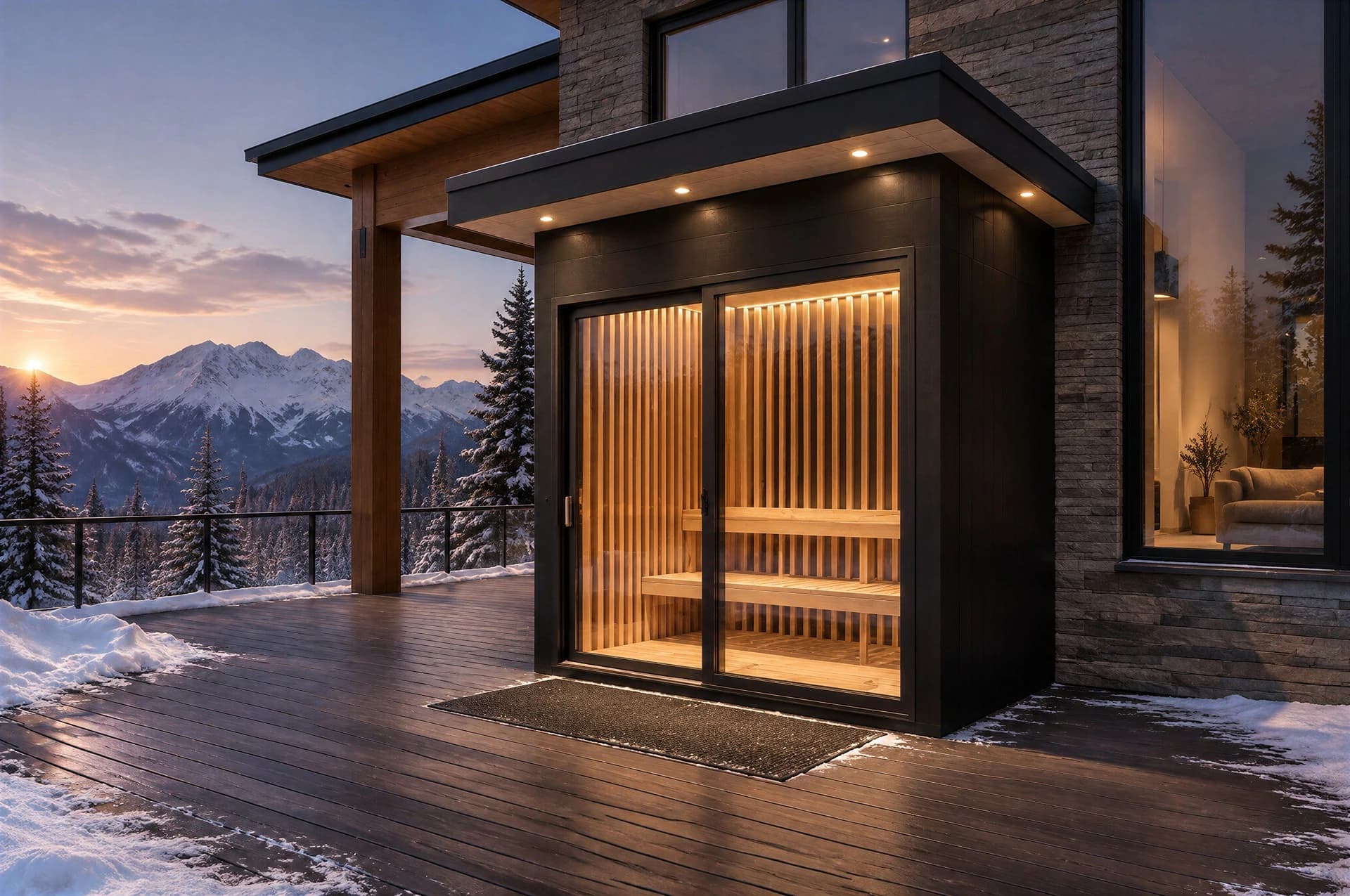
SaunaCloud’s illustrated outdoor configuration shows a 240V hardwired setup, but the company also states that final circuits are project-specific. That distinction matters. Never size electrical service from a model name or a blog post.
For the basics, read our 120V vs 240V infrared sauna electrical guide.
6. Ask how winter changes performance
Cold outdoor air increases heat loss. That does not automatically make an outdoor infrared sauna impractical, but it can increase preheat time and place more importance on enclosure quality.
Ask the manufacturer for winter-use assumptions:
- Minimum recommended outdoor temperature
- Expected preheat behavior in cold weather
- Insulation specification
- Door and glass details
- Snow-load requirements
- Freeze-thaw foundation guidance
- Any winter shutdown or maintenance procedures
7. Compare outdoor infrared, traditional and barrel saunas by experience
These formats can all look appealing in a backyard, but they deliver different experiences.
Outdoor infrared cabin
Best suited to buyers who want radiant heat, lower room-air temperatures than a traditional hot-rock sauna, app-style controls, and potentially a more customized enclosure.
Traditional outdoor sauna
Best for buyers who specifically want high air temperatures, sauna stones and the classic hot-room ritual. Electrical or wood-fired heating changes installation and maintenance requirements.
Barrel sauna
Best for a compact site and distinctive look, but compare usable bench space, insulation, weather sealing and heater clearances instead of buying on shape alone.
8. Decide whether red light integration actually matters to you
Some outdoor infrared systems now combine heat with red and near-infrared lighting. SaunaCloud’s current system uses bench-integrated nominal 660 nm and 850 nm LEDs in configured builds. Integration is convenient, but the existence of red LEDs is not proof of a medical outcome. Exposure depends on distance, output, timing and protocol.
If red light is a major reason you are buying, ask for wavelength, placement, control options, electrical design and testing rather than assuming every glowing red cabin is equivalent.
9. Read the outdoor warranty separately
Outdoor products have more environmental exposure, so warranty language matters. SaunaCloud’s current residential coverage lists seven years on heaters, three years on power and controls, one year on covered accessories, and a separate three-year outdoor roof warranty. Wood, labor, diagnosis, electrician costs and some other items are excluded.
The lesson is broader than one brand: compare component-by-component coverage, outdoor-specific exclusions, shipping responsibility and who pays labor if a covered part fails.
10. Plan delivery and site access before ordering
A large sauna project can involve curbside freight, multiple boxes, long wood components and contractor staging. Measure gates, stairs, side-yard access, elevator dimensions and deck routes before the shipment arrives.
If a crane, lift, special delivery appointment or street permit could be needed, solve that before purchase. “Free shipping” or a flat freight charge does not mean materials magically appear in the finished backyard location.
Who should consider an outdoor infrared sauna?
- You want to preserve interior floor space.
- You already have a patio, pool area, home gym or backyard recovery zone.
- You want the sauna ritual physically separated from the house.
- You are comfortable coordinating site prep and electrical work.
- You value custom dimensions or an architectural look.
Who may be happier with an indoor sauna?
- You want the simplest installation path.
- You live in a harsh climate and do not want exterior maintenance.
- You want easier electrical routing and year-round access.
- You prefer a prefab system with minimal site work.
Bottom line
The best outdoor sauna is not simply the one with the nicest product photo. It is the one engineered for the actual site. Foundation, drainage, insulation, electrical design, roof details and service access should be decided before the sauna is ordered.
If you want a custom outdoor infrared build, review SaunaCloud’s current outdoor sauna options here (paid link) and use the checklist above to evaluate the proposal against your climate and local trades.
FAQ
Can any infrared sauna be installed outside?
No. An indoor cabin may not be designed for rain, UV exposure, freezing temperatures, outdoor electrical requirements or snow loads. Use a system explicitly designed and approved for outdoor installation.
Can an outdoor infrared sauna work in winter?
Yes, if its enclosure, insulation, heating capacity, foundation and electrical system are designed for the climate. Expect colder weather to increase preheat time.
Does an outdoor sauna need a concrete slab?
Not always. A properly designed paver base or reinforced deck may work, depending on weight, local conditions and manufacturer requirements. The key is a level, stable, drainable base.
Do I need an electrician?
For hardwired outdoor systems, yes. A licensed electrician should follow the manufacturer’s project-specific drawings and local code.